


Strava released its 2025 Year in Sport Trend Report this month, pulling from 180 million users and 30,000 survey respondents. Running still dominates, walking is growing fast, and Gen Z is racing more and spending more on fitness. Let’s dig in.
Gen Z Gets Fit
65% of Gen Z says they’re directly affected by inflation. Yet 30% plan to spend more on fitness in 2026, and 63% identify wearables as their biggest fitness investment in 2025.
Why is a generation under so much economic pressure treating fitness spending as non-negotiable? One explanation is the growth and normalization of fitness (specifically lifting) in influencer culture.
It feels more like the gym is harder to avoid as it’s grown as a sellable and brand-able model for influencers like Nick Barre, Sam Sulek, Alex Eubank and Faith Ordway. Every app has influencers serving up infinite variations of gym content, viral “daily fitness routines” and “hybrid athlete” training.
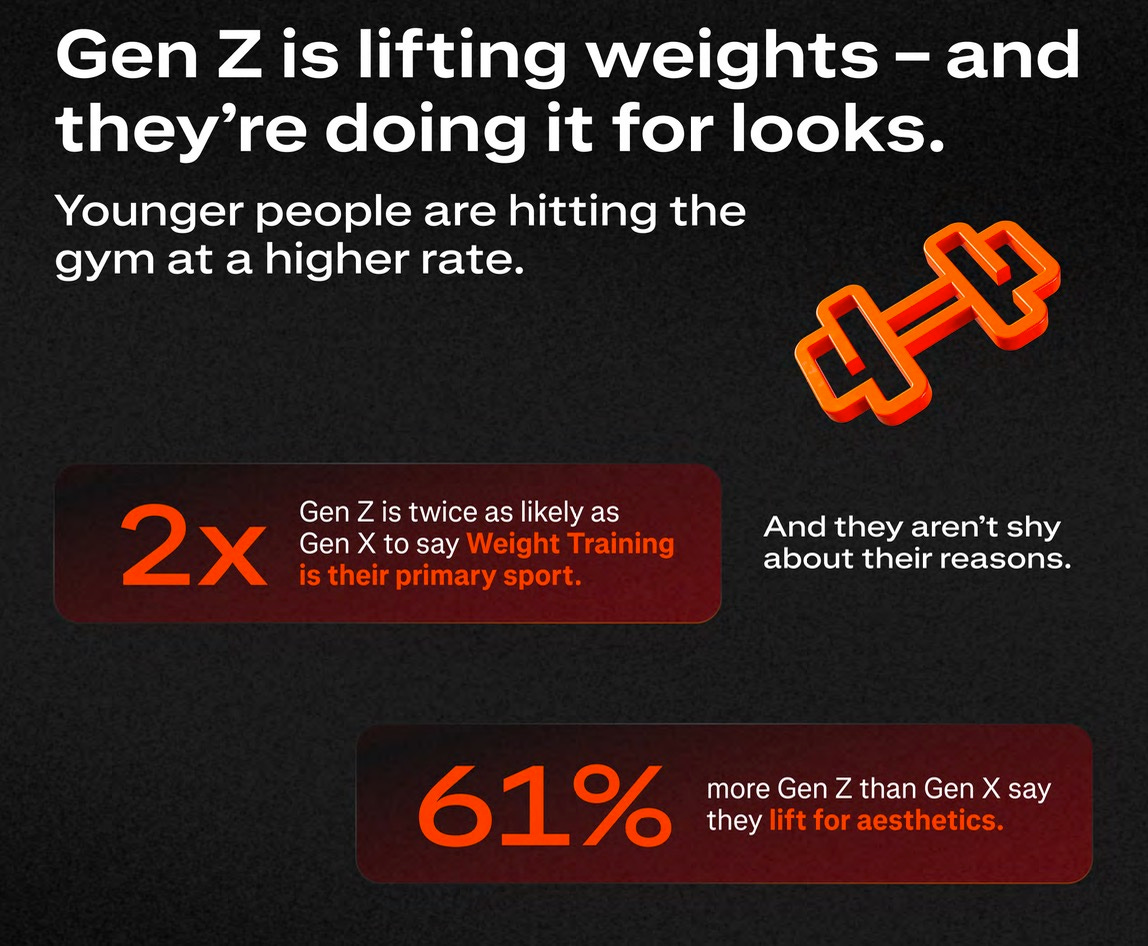
I don’t think the majority people see this type of content and immediately decide to run a marathon or sign up for Hyrox. But when you see this kind of stuff over and over in your feed, and follow other folks fitness journeys, over time it can shift what feels normal. Running becomes something people your age just do. Lifting feels less niche. Signing up for a race feels like a reasonable thing to try.
Run Clubs and the IRL Economy
Strava Clubs nearly quadrupled in 2025, with over 1 million clubs total. Running clubs increased 3.5x. Club events increased 1.5x versus 2024.
There has been a LOT written about run clubs this year. They’re the new dating app. They’re the new “third space”. They’re replacing bars. 37% of the survey respondents view run clubs as good places to meet people.
People are using fitness as a replacement for other forms of social interaction that have fallen out of fashion or moved online. If fitness is your primary source of IRL social contact, it’s no longer discretionary spending. It’s necessary social spending that happens to involve exercise.
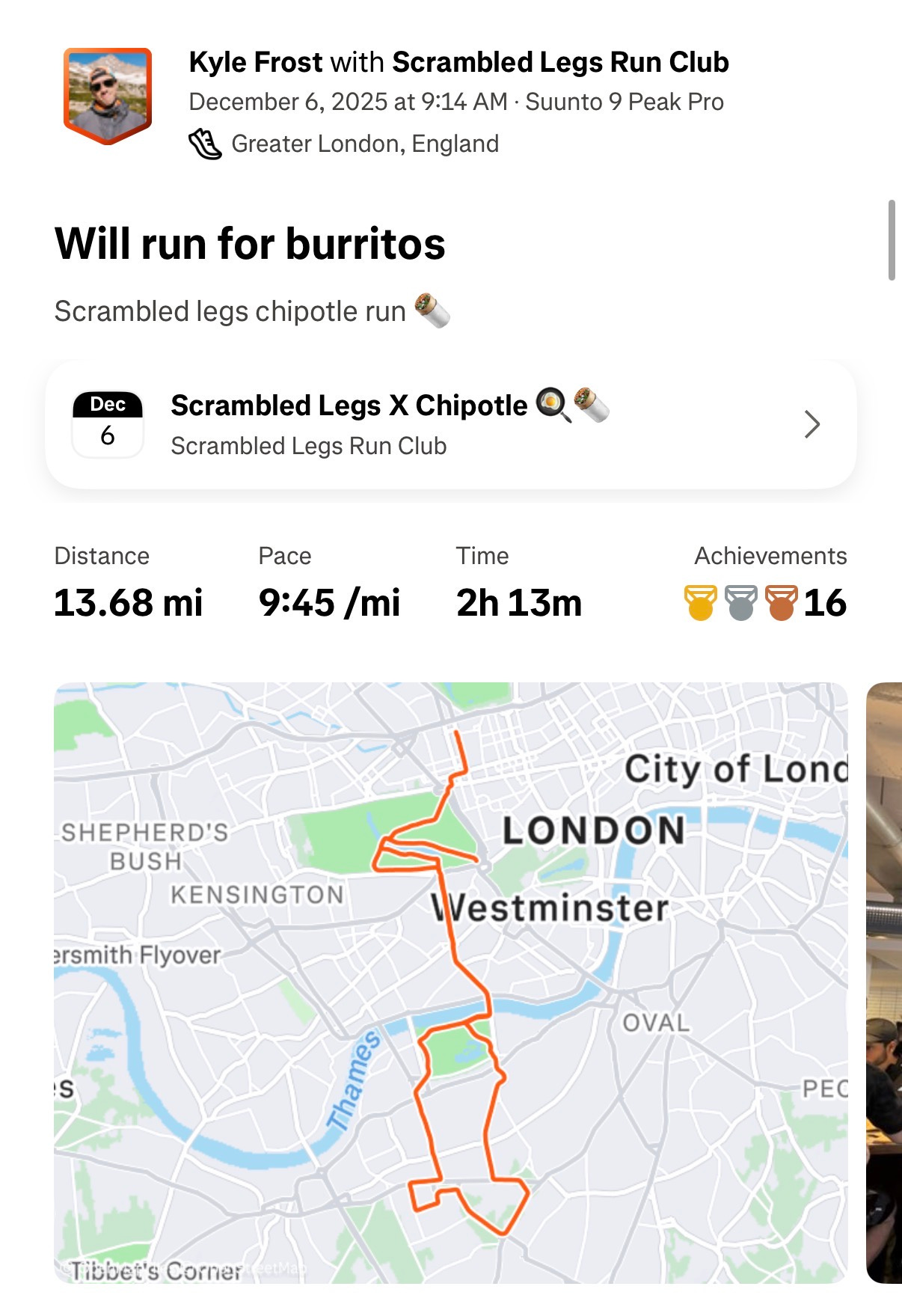
The run club boom is definitely not evenly distributed. 27% of women and 20% of men said they view run clubs as only for elites, and this perception skews towards older athletes. Honestly this feels even slightly low to me, and it’s a feeling I’ve definitely experienced on my own, depending on the club. I’m rarely worried about ‘elites’ or pace, but there’s no question that certain clubs have a vibe. Nothing wrong with that, but it’s an interesting social friction that is occasionally involved.
If Strava’s fastest-growing use case is more tied to IRL connection vs training optimization, I’m curious to see how they continue to develop feature-wise. Advanced analytics matter to serious athletes, but social features and club infrastructure might matter to the growing user base. I think we’re likely to see this investment in club/social features continue, as well as development of the race search (and probably registration, eventually).
Staying Motivated
Gen Z is 75% more likely than Gen X to say their main motivation is a race or event.
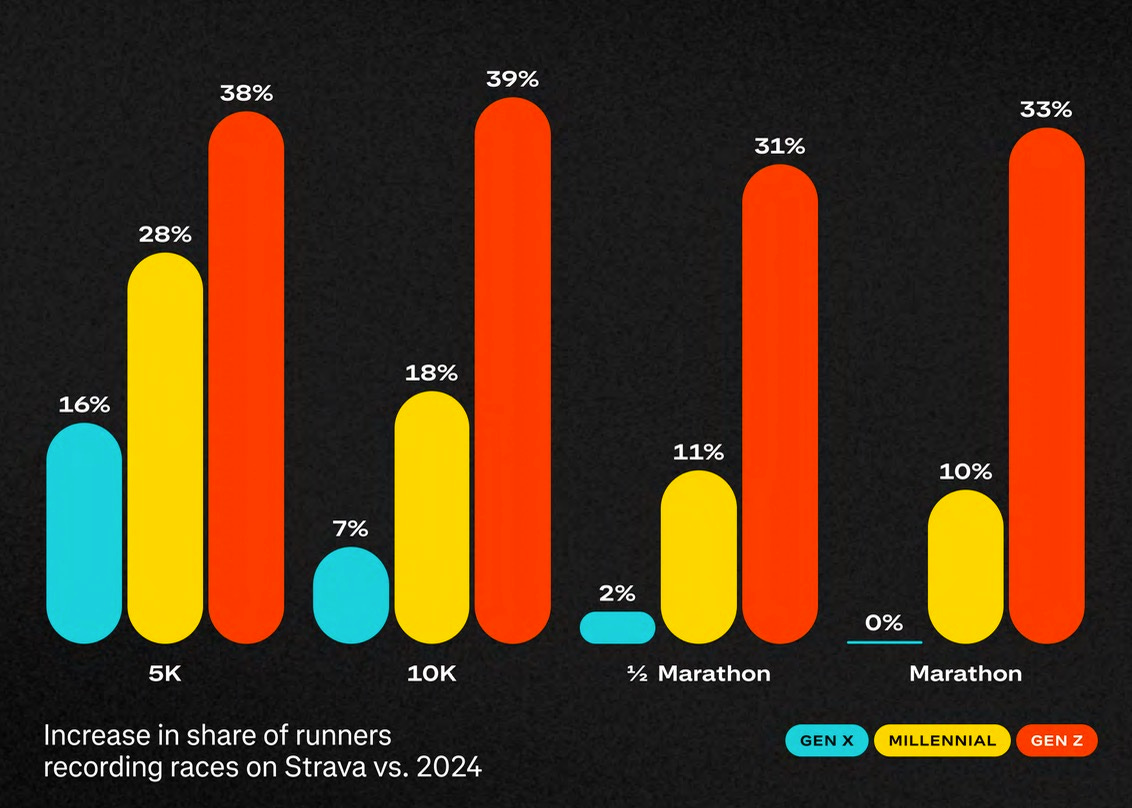
There’s a real difference between being motivated by races and sunk costs and developing an intrinsic love for running itself. I’m never in better shape than when I’m training for a race, mostly because I’m too competitive to treat “finishing” as the goal. But I don’t race very often, and I love nothing more than a long run through the mountains or countryside with no time limits, no pace, and no one watching. A race is just a measurement of something I already enjoy, not the reason I do it.
Looked at cynically, the surge in race participation can feel more transactional: sign up, document the training, post the finish line photo, collect the medal, the Hinge photo, and the validation.
The running industry has done a pretty good job of creating ever-moving goal posts. Run a marathon, then a World Marathon Major, then all six Majors, and oh, just kidding now we’re adding more. There are similar pathways in trail, but more tied to increasing distances and UTMB.
What “Using Strava” Actually Means
72% of Strava users recorded a workout using the mobile app directly. Garmin was second, Apple Health third. 14 billion kudos were given in 2025, up 20% from 2024. Activities with photos get 3.1x as many kudos as those without.
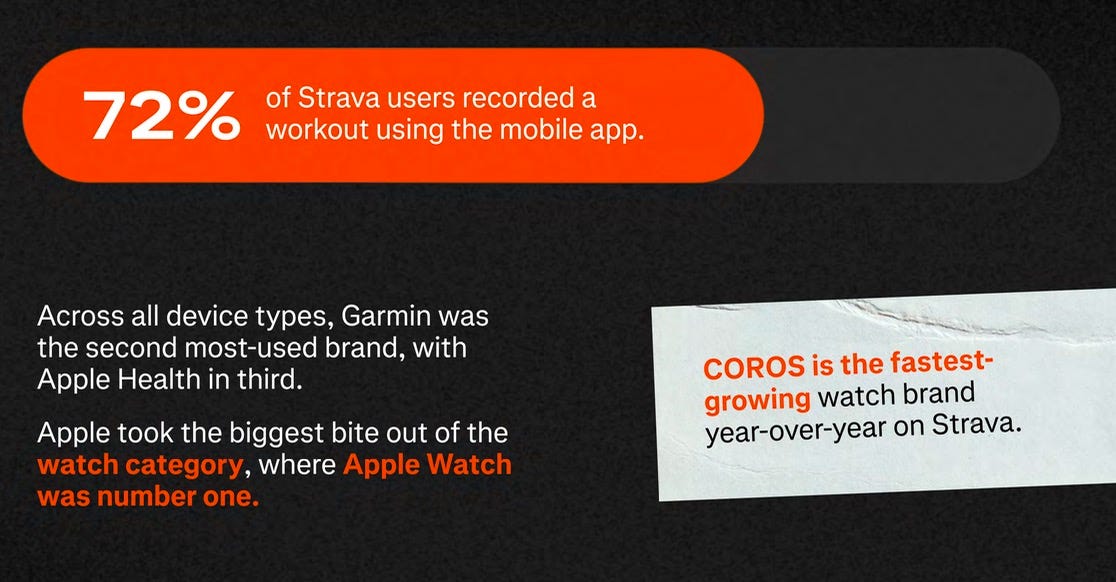
I assume “used the app” means at least once over the course of the year, even if you use a watch most of the time, which maybe makes this slightly misleading. But if you’re a Garmin/Suunto/Coros user with a strong opinion about Strava as a platform, it’s worth noting that you’re already in the minority. This gap between power users and casual users helps explain why Strava’s product decisions often feel disconnected from the loudest user complaints.
There’s a strong case that Strava is not primarily an activity tracking app or even a training log. It’s a social network where the price of posting is physical effort. You share proof that you exercised, and in return the community delivers validation in the form of kudos and comments.
That feedback loop is not without criticism. For some people it can distort training behavior, encourage overtraining, and result in injury. Still, it is remarkable that they have managed to scale and monetize a social loop, reaching hundreds of millions of people, that is contingent on people being active. As far as social media tradeoffs go, exchanging likes for movement feels like a relatively healthy bargain.
A few more things
Of course, at least some of this has been carefully crafted for maximum PR effect. But, if I put my product hat on, I’d have a few follow-up questions (that I’m sure they’re looking at internally). Here are a few questions that feel critical to Strava’s long-term strategy:
They’d never share this, but I’m curious where is the biggest growth in *paid* usage is coming from.
46% said they would use AI as a smart coach (aka Runna). I think there’s a lot to be written about this.
Races are clearly big, but there’s probably some fascinating cohort analysis about training and usage pre/post “first” races.
Are people in active clubs stickier than solo users?
Hiking saw a massive growth in clubs (5.8x YOY), and I’m curious about how those folks use Strava vs run-focused users
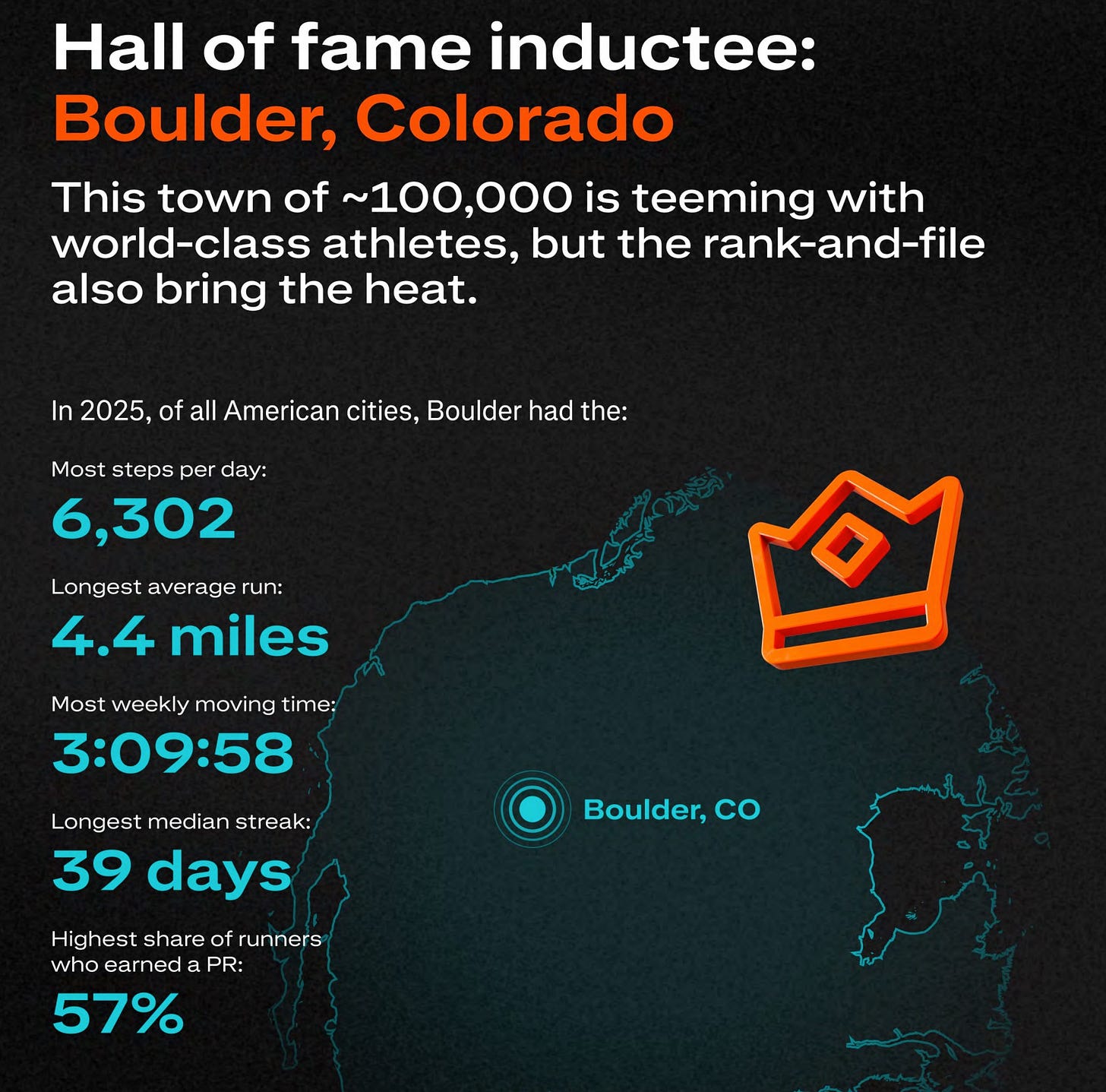
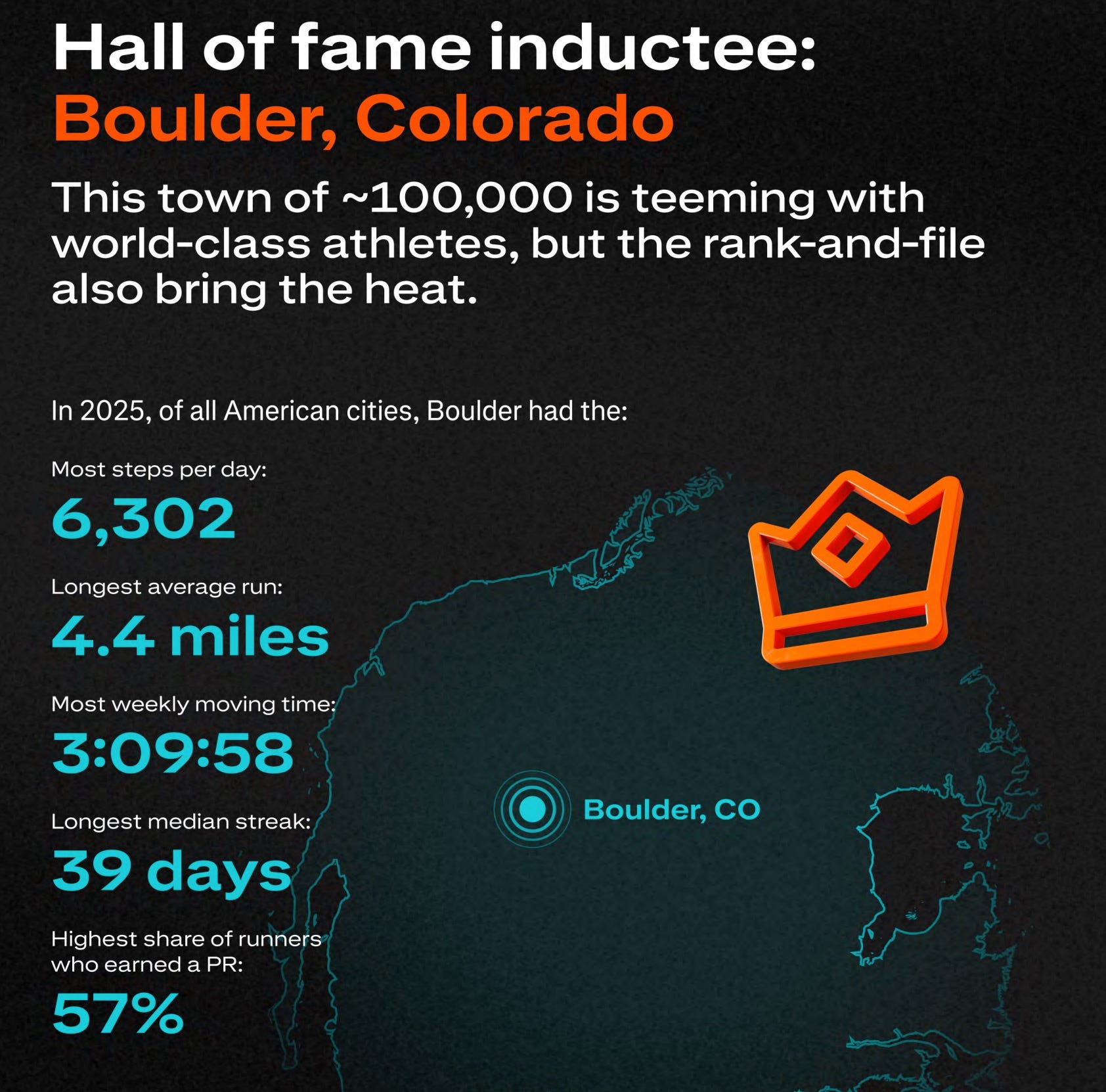
And finally, perhaps the least surprising news of all time, Boulder is a bit insane.
"Still, it is remarkable that they have managed to scale and monetize a social loop, reaching hundreds of millions of people, that is contingent on people being active. As far as social media tradeoffs go, exchanging likes for movement feels like a relatively healthy bargain."
Paraphrasing a line I heard from somebody else, I think Alex Predhome, credit to Strava for being the only social media network that makes you actually touch grass before you can post.