


I wrote a few weeks ago about running the Mischabel 60k, where I finished 17th overall, which, honestly, was better than I expected. My ~12-week training block wasn’t planned by a coach. I spent the summer talking to a chatbot instead.
People are asking LLMs about things they never would have considered just a year ago, whether it’s where to hike this weekend or how to train for a marathon. It’s not always a great idea, but I was looking for a bit of structure going into a race, and decided to use myself as an experiment.
I’m not making a case for AI as a replacement for a real coach. But it was an interesting way to dig into what works and what doesn’t (at least right now).

There are a lot of apps doing this
There’s a whole category of training software that is marketed as AI-first, and vibe-coding has only exploded the segment. TrainAsONE rewrites your plan whenever you miss a run. Athletica sells its engine to human coaches so they can manage more athletes. Eliud Kipchoge has his own AI coaching startup. HumanGo gives you an AI coach named Hugo. Then there’s the long tail: Coach Leo, Running Genie, RunWatch, and free templates that do much the same thing without a line of code.
Irrespective of scale or funding, these apps usually combine the same two inputs: your activity history (often from Strava) and an LLM. It raises an obvious question of what most of these are actually selling. The training logic isn’t proprietary; most of it is available in research papers and widely shared training philosophies (which is why they all advertise themselves as “science backed”). They point an LLM at training plan data, then at your data, and generate a plan. Depending on the depth/attention to detail, there are generally a few more checks/loops, but yeah, that’s basically it.
The differences lie mostly in the design and whatever trust a brand can build before the next app shows up…which is a pretty thin moat.
How I built my version
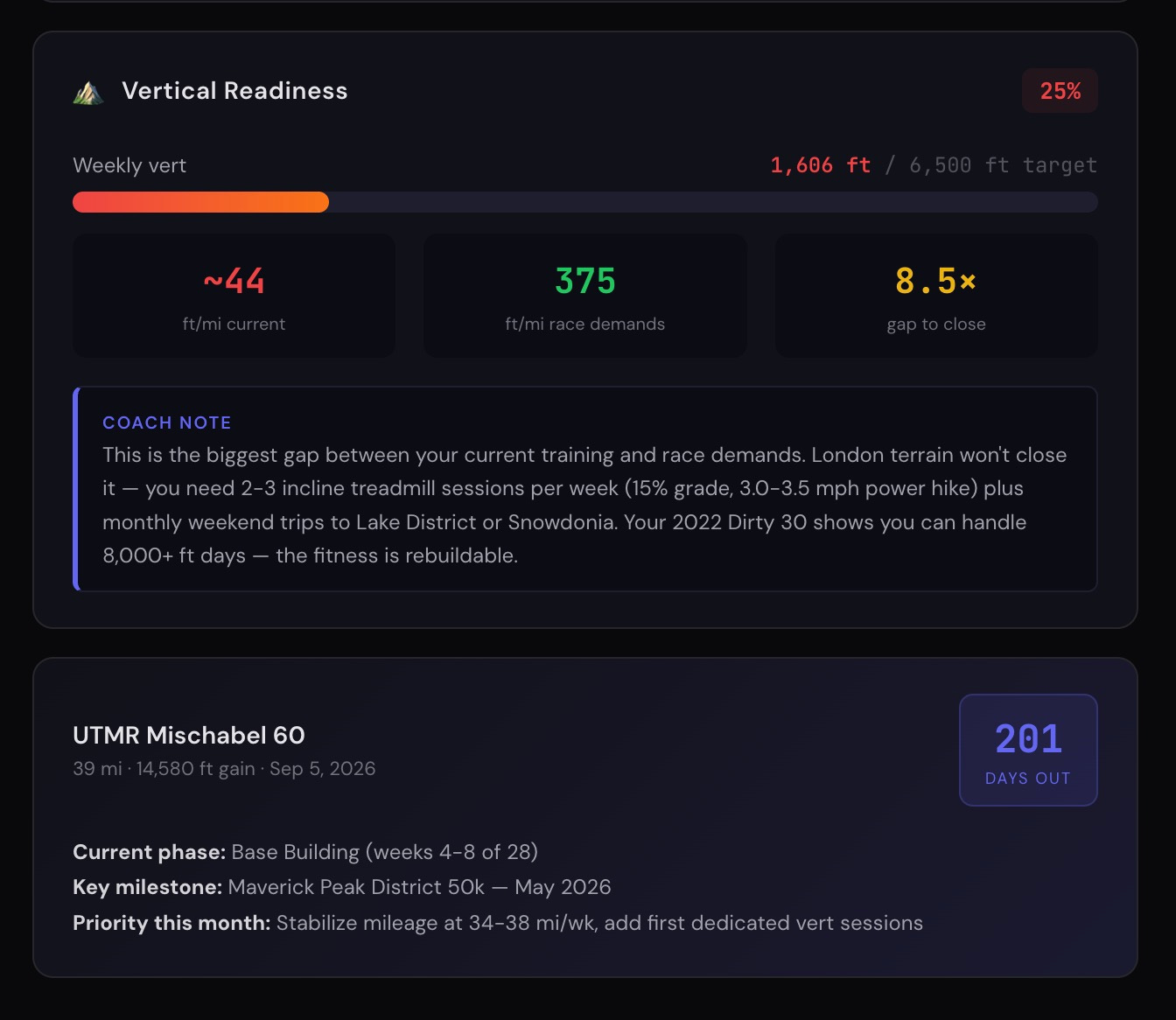
In late December 2025 I built a Strava-connected coaching bot. It was a standalone app, connected to a CSV download of my recent Strava data. I gave it a pretty detailed set of context about me: current mileage, where I live (no access to good vert in London), and currently no race in mind. When I added a couple of potential target races for the spring or summer (Mischabel 60k being one of them) it basically told me that I was woefully underprepared for a mountain race given my current mileage and lack of elevation training.
I shelved it and kept running without much of a plan through the spring. Then in June, the Strava Claude MCP launched. I got everything hooked up to Claude and had a conversation with it about my data and my goals. It pulled a full history of my Strava activities and the race details, and came back with a read of my fitness and a 12-week plan.
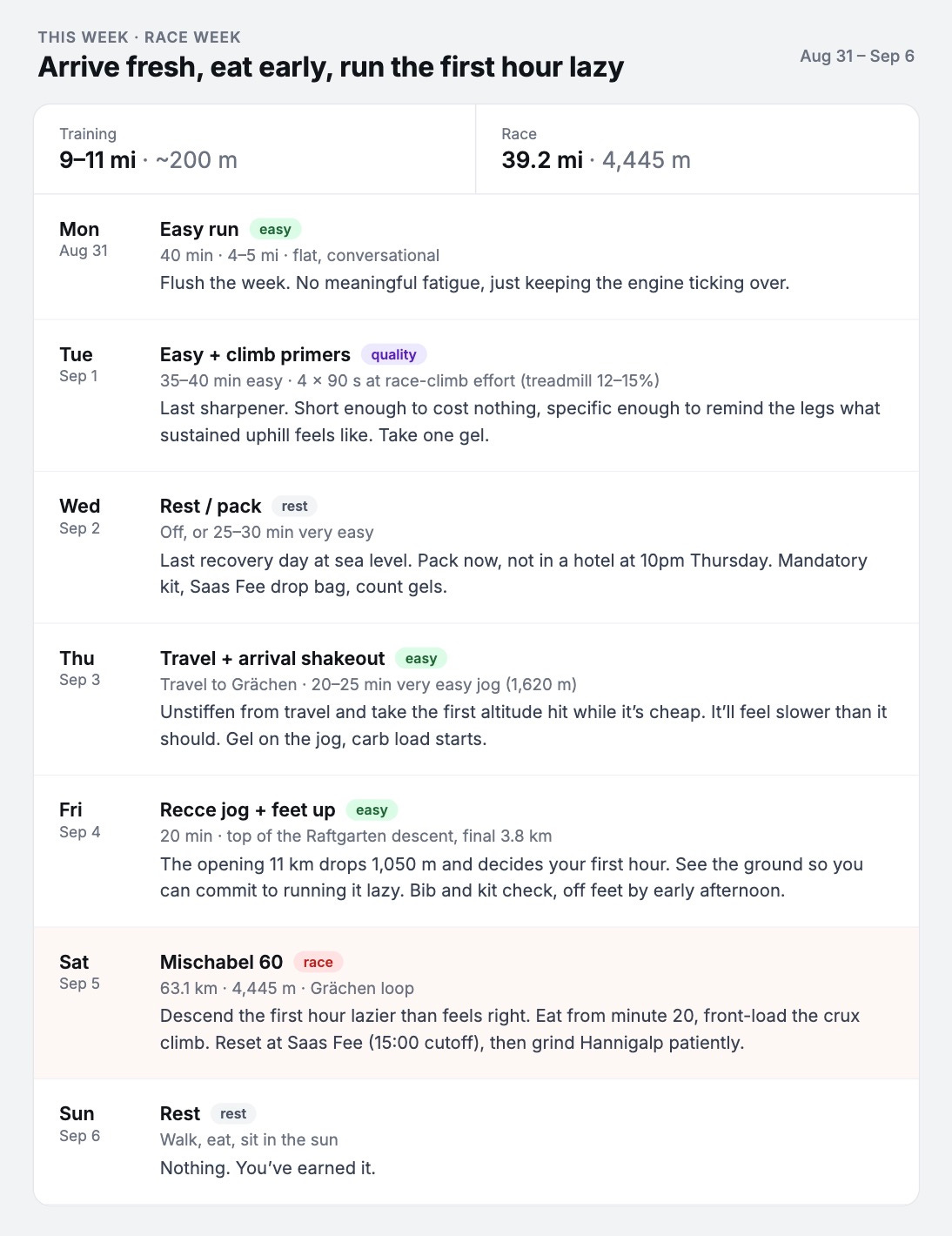
The implementation was intentionally light. I used the “scheduled tasks” feature and it pulled my recent activities directly from Strava every Sunday evening rather than me needing to dump in a CSV. It compared my last 7 days of Strava data with the previous week’s plan, benchmarked it against the original plan, took into account any additional information I provided throughout the week, and then generated an adjusted plan for next 7 days.
What went fine
The plans themselves were solid, if not revolutionary, with a sensible mix of easy and hard days, short and long runs, and treadmill incline work to make up for London’s lack of hills. It’s not rocket science. It also did a pretty good job of adapting, because every Sunday it was grading what I actually did against the weekly plan. In late July it cut targets for a “peak” week once it was clear I wasn’t going to hit them. At one point it made up a new metric, “climb density,” to more succinctly explain that I consistently wasn’t getting enough elevation (hey, training for a mountain race is tough in London).
In the middle of the block, I added more detailed data on the course and previous finishers (turns out I had been using a previous year’s route). One of the climbs is over 6k ft, and Claude revisited weeks of its own advice because it wanted me to be better prepared for long stretches of continuous climbing.
It got more useful the more I told it. I had a knee tweak in August, and it adjusted the plan once I told it about the issue. I added context about vacations, and it changed plans when I was clear that I was not going to hit goals on a brutally hot travel week to Colorado for a wedding.
Looking back at the full scope of the conversation, there are also plenty of random things, like me in a hotel room in Grächen the night before the race asking whether a pain au chocolat or a Butterweggli was better for a race morning breakfast.
What Claude couldn’t see
While things mostly went pretty well, it did break down in a few places. Not in hallucinated facts or “bad” training recommendations, but usually failures of context, which is slightly more annoying, because then it’s technically “my” fault.
One example: on June 28th I ran 16 miles in the New Forest while working on my gel fueling (this was my first time racing since the high carb craze took off), and my stomach wasn’t adjusted to eating gels for three hours. I mentioned my stomach issues in the Strava activity and Claude picked that up in the next check. It turned that issue into a whole fueling protocol. That’s fine, but that “issue” remained a staple of suggestions for weeks and weeks because it got added to the root prompt.
I sorted out my stomach issues after a few runs, but for whatever reason I never explicitly told Claude that it was “solved.” A coach would have asked how my gut was doing, learned it was fine, and dropped it. Claude had no way of finding that out unless I told it, and I kept forgetting to.
Mid-week, it would sometimes say it had updated the plan without actually changing anything, because my original instructions only told it to re-evaluate the full plan on Sundays. Treadmill power hiking doesn’t come with elevation in Strava, so unless I explicitly added it, those workouts weren’t accurately accounted for in plan updates.
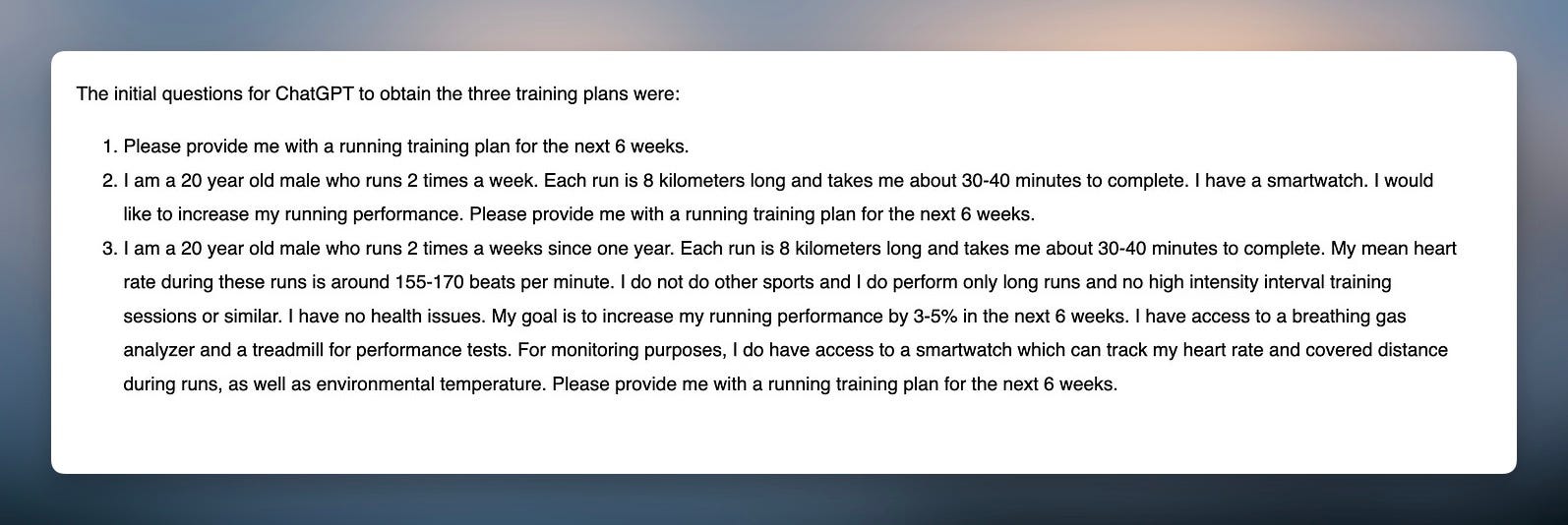
A 2024 study asked coaches to rate a selection of ChatGPT training plans, with the only difference being how much information about the runner the LLM initially received. The vaguer prompt scored a 2/5, and the more detailed one (only a few sentences more) a 4/5. Unfortunately, there was no coach-written plan in the set to compare against. That means the research can’t say that AI plans are worse than a human’s, only that they’re likely to get better the more information you provide.
That tracks with what my experience was like. I’ve spent many years designing/building software, and a good chunk of the last few working with LLMs (on things like automating construction permitting). I know both what a reasonable training build looks like, and understand the limits of prompts and context. A lot of what went right was the result of me asking the right questions and providing the right info.
Someone newer to running and with less LLM experience might have a different result. An LLM will confidently give you a plan whether it’s good or bad; if you don’t know how or when to push back, you’re kinda stuck. That doesn’t make the whole thing pointless, but it is a significant snag in the process.
The case for humans
Not everyone will be happy I’m even writing about this. The outdoor industry’s relationship with AI is…fraught, at best. There will be people who unsubscribe as soon as they see the title. But I’m not here advocating for everyone to switch to an “AI coach.”
I think we can agree that the ideal coach is one who knows your history, your job, your sleep habits, and your previous injuries, and is able to adjust accordingly. These people exist and are worth every dollar.
When people share why coaching worked for them, it’s almost never the plan they point to. It’s the accountability and the relationship that a coach provides. Claude didn’t actually care whether I ran or hit my goals each week (although it did get a bit testy a few times), or even how my race went. I didn’t have money invested in the relationship, and I wasn’t worried about “disappointing” Claude.
But a great coach can be hard to come by. There’s a wide range of quality in the industry, and sometimes what you’re actually buying is a generic template with your name on it, slightly adjusted in a spreadsheet once a week. Which is, more or less, what Claude was doing. I wouldn’t be surprised if some influencer-type coaches are leaning heavily on AI behind the scenes. There’s a whole separate conversation about whether it matters if a coach uses AI, especially if the most important things they provide are actually the less reproducible aspects of the relationship.
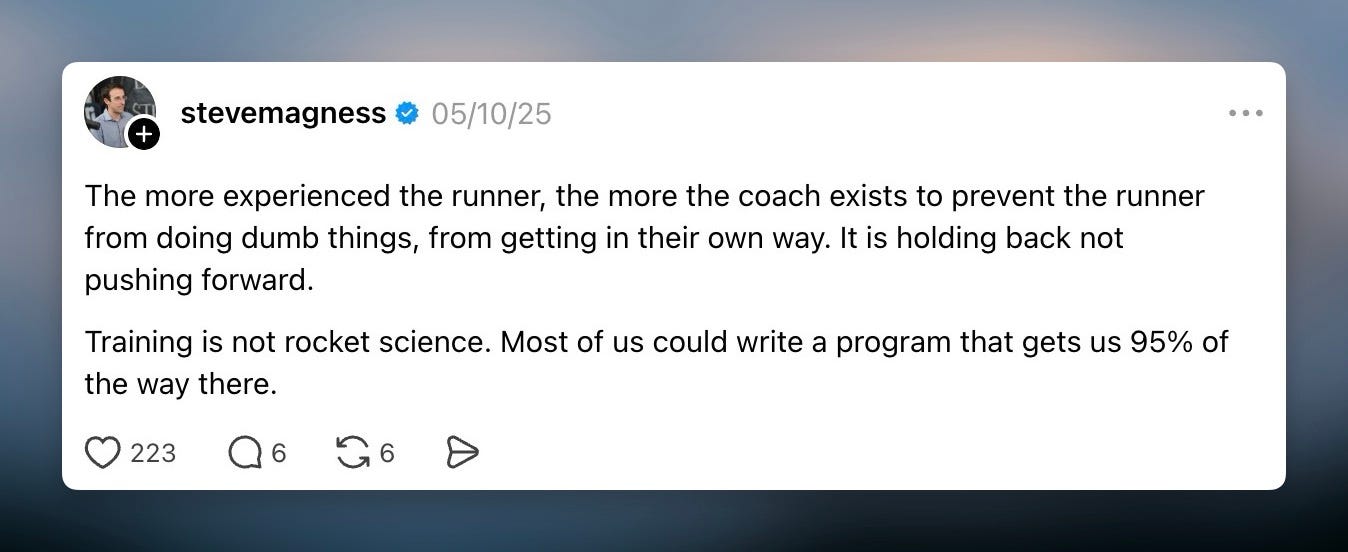
After all, a lot of endurance training is pretty formulaic. Build volume, don’t build it too fast, keep easy days easy, adjust things up or down X% every week based on how you’re feeling. Yes, that’s a simplification. But I’ve also had conversations with a few coaches who acknowledge that some of the actual plans…aren’t really that complicated.
The hard reality is that a human coach isn’t cheap. I was never going to spend a few hundred dollars a month on a coach. I’m not serious enough to invest deeply in training. I’ve been faking my way through road, trail, and ultras since I got dropped from the UC San Diego cross country team because of injury 15 years ago (I played four years of ultimate frisbee instead).
What I needed was structure with a bit of customization, and that’s what Claude provided. And I suspect that’s all a lot of people really need.
Where that leaves me
A week out from the race, Claude built me a pacing sheet with A, B and C targets. The B target was 10:18. I ran 10:39. For a first go at that distance and that much climbing, I think that was a pretty decent estimate. It’s also a good example of the gaps in a nutshell; it couldn’t really model the effect of a more technical course and how the downhill would hit my fit (but not super downhill fit) legs.
I don’t know what any of this proves about AI training. There’s a whole boatload of caveats here, from my decent baseline fitness to my experience with LLMs. It might only prove that having a plan slightly beats not having one…for some people. Ironically, I’m currently struggling with a knee issue, not because an AI pushed me to overtrain, but because I banged my knee playing volleyball and apparently I’m at the age where that can take me out for a while.
If I’m being honest, there’s a good chance I’ll fire up Claude if I have a race to train for next year.