




Hey y’all, this is a bit of a rant. I know it’s a rant. I’m not usually this salty about things, and I don’t really care this much, but the words kept coming and it was fun to write. Enjoy 😂.
If you’re around London and want to grab a coffee and chat about the outdoors/brand/H&T/AllTrails/etc, I’ve got a bit of time over the next 2 weeks. Say hi.
~Kyle
There’s a new niche on social media that I like to call the “Gear Slopfluencer”. They’ve obviously never touched most of the gear they talk about, can’t pronounce half the names, and have little to offer in commentary besides vibes. They come in different flavors (the Instagram talking head, the two dudes with a podcast, etc), but they share a few consistencies. Everything is short and snappy. They love catchy juxtapositions against the “overrated” or “popular” brands like The North Face, Arc’teryx, Patagonia, and Salomon. Every discovery of a “new” brand is shared with breathless energy. It’s not always lists, but it’s often lists, and people love lists.
It’s a perfect recipe for the algorithm, and people eat it up.
How to be an outdoor expert on social media:
Establish obscurity
“You’ve probably never heard of this brand, but they’re huge in [non US region].”
“Really underrated. I don’t hear anybody talking about them.”
“Pretty solid recognition in the [niche] community.”
Cite unnamed sources
“I’ve been hearing really great things about them.”
“Everyone I know who’s tried them loves them.”
“From what I’ve heard, their stuff holds up really well.”
Discuss design
“Such a cool design language.” (Works for anything, regardless of what it is)
“The fabric, the fit, the branding… everything is awesome.”
“If you go to their website right now, you’ll know what I’m talking about.”
Check the vibe
“Just a really clean look”
“The colorways on these are insane”
“You can tell just by looking at it”
Sound technical
“They’re doing some really interesting stuff with materials”
“Their engineering is on another level”
“They’re using [specific feature or branded material].” (No elaboration needed)
Close with a hook
“Drop your favorites down in the comments.”
“If I missed any, let me know and maybe I’ll make a part two.”
Honestly, hats off to the people who figure out what works. A few of them probably make a tidy business out of it (despite the conspicuous lack of ad disclosures anywhere I’ve seen). I’ve got a head full of reading and research and a decent eye for trends, and I don’t have the stamina to feed the machine every day. It's a talent to string so many words together in a way that sounds informative, engaging, and exciting and yet speak in such meaningless platitudes that you could copy paste every observation to the next brand.
Every jacket is your favorite jacket. Every shoe is the one you “genuinely reach for.” Despite that, you’ve got another one you’re “so excited about” two weeks later. Disclosures? Shhhh, we don’t talk about disclosures here. The nature of algorithmic feeds means that no one really cares or notices that there’s no continuity or sense to your recommendations.
I think it’s cool to help people discover new gear and brands. But discovering them doesn’t make them new or make you an expert. There’s a jarring disconnect when I see someone positioning themselves as some kind of gear luminary while remaining oblivious to the actual landscape or history of well-known outdoor brands. But, it’s not that surprising when you just assume these folks are writing generic scripts with AI, with all the foibles and misrepresented info that involves.
Don’t tell me that Salomon shoes are low quality and only for fashion. The Genesis remains one of the most popular trail shoes on the planet and Courtney Dauwalter (the GOAT) races in them. I saw a dozen different Genesis and S/Lab Ultra Glides at UTMR. Presumably, the people racing one of the harder 100-milers in the Alps picked them for their performance and not a fit check.
Don’t tell me that The North Face jackets suck. If you want to talk about lifestyle’s influence on brands, fine. But you cite the Nuptse (the one jacket mentioned in every gorpcore article ever written) as a jacket that can’t possibly be good because it’s worn in cities, and then ignore the rest of TNF’s line (like the 25-year-old Summit Series).
Don’t mispronounce names and identify brands that are iconically from one country as being from another. You’re not going to convince me that was an honest mistake. You just have no idea what you’re talking about.
The alternatives to these incumbents? More often than not it’s some new brand slapping their edgy logo on blanks of this season’s hot fabric and shipping straight from Vietnam. But sure, I guess that’s better than a brand that has real sustainability efforts, goals, and public data. And yeah, new small brands are cool. They’re usually more interesting, and sometimes they’re doing things better. But that nuance is lost when your latest take is simply oblivious to what other brands are actually doing.
Begging for scraps
And I see you all down there in the comments, begging for scraps at the altar of the algorithm. Blue check brand accounts dropping 🔥 emojis with “pick me” energy, desperate for a mention in next week’s vibes-based ranking of puffy jackets. Hoping some “expert” discovers that your iconic 50-year-old brand exists or slots you in as an A-tier whatever, for no reason in particular. You spend years (or decades) building a brand, and success in 2026 is boiled down to a pithy mention in another list between a fit-check and an AI influencer.
I see you PR companies, shipping off that free gear, gleefully courting whoever holds the most attention this week, hoping for a nice impression bump that will look great on a quarterly performance slide. You know they’re full of shit, but then you get a look at their follower count and engagement metrics, and suddenly…that shit smells like roses.
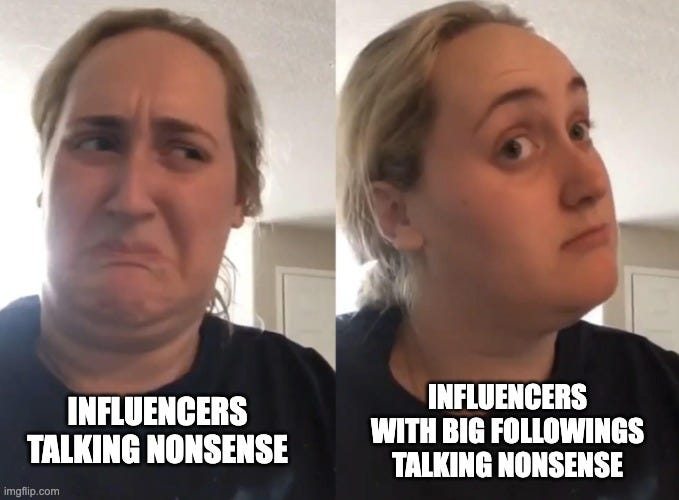
And yeah, that’s just how things work these days. Everybody wants a piece of attention and everybody is trying to figure out how to get it (including me). I’m not anti-influencer. There are plenty of people out there who know their stuff, some with big followings and a lot without. But real expertise is harder to spot; it usually isn’t very glamorous and it isn’t what the algorithms reward. To be fair, it’s not what we reward either. Most of us will scroll past a careful review and stop for the snappy, confident list, whether it feels informed or not.
It’s a weird world, when expertise becomes more of a performance instead of something that is earned. And again, hats off to those with the personalities to pull it off. All it takes is a ring light, a ChatGPT subscription, and the confidence to pronounce Mammut however you’d like.
There's also this unspoken rule that nobody will admit: To make money as an influencer (especially on IG), you need to hawk dozens of products. But as an individual influencer, it's literally impossible to adequately test or use the amount of gear necessary to keep an income afloat. Especially in a place with four seasons. Unless you're a full-time sponsored athlete or adventurer, there is no way to know if that zipper is going to break after 100 uses or it will lose its waterproofing at the seams in a month. Sorry, it doesn't rain that much in San Francisco.
This made me laugh, Kyle, particularly the bit about design language!
But your point about PR teams chasing these accounts is painfully familiar. I've worked in both journalism and communications, and it's remarkable how quickly reach can become a substitute for credibility.
If everyone's reporting impressions and engagement numbers, who's asking whether the person recommending the gear actually knows anything about it? Brands have helped create this problem, and now they're feeding it.