


Hey all, hope you’re well. Stumbled into this one this week while doing a bit of recon on a few other stories. Was too interesting not to share.
It was below freezing this morning, which has me starting to think ahead about winter, skiing, travels, and more. Let me know if there’s anything on your mind when it comes to stories or otherwise. Thanks for reading!
~Kyle
Instagram’s algorithm served me a suggested account the other day that tickled all the wrong parts of my lizard brain. Brooke Wilder seems like a run-of-the-mill gear influencer. She’s posting photos of her tent at sunset, walking on a tree-lined trail wearing a new backpack, or “YouTube” posed on reels promoting her latest gear review. Her latest posts highlight products like the Outdoor Research Echo hoodie, the Osprey Aether 65, and the BioLite Range 500.
But Brooke has never worn that headlamp. Or the backpack, or the hoodie. In fact, Brooke has never worn anything. She’s a homunculus cobbled together with code, an AI-generated persona, and the “byline” of a new “gear review” website (I apologize in advance for the amount of gratuitous quotations) that is itself stitched together by LLMs remixing the work of real people on other gear sites.
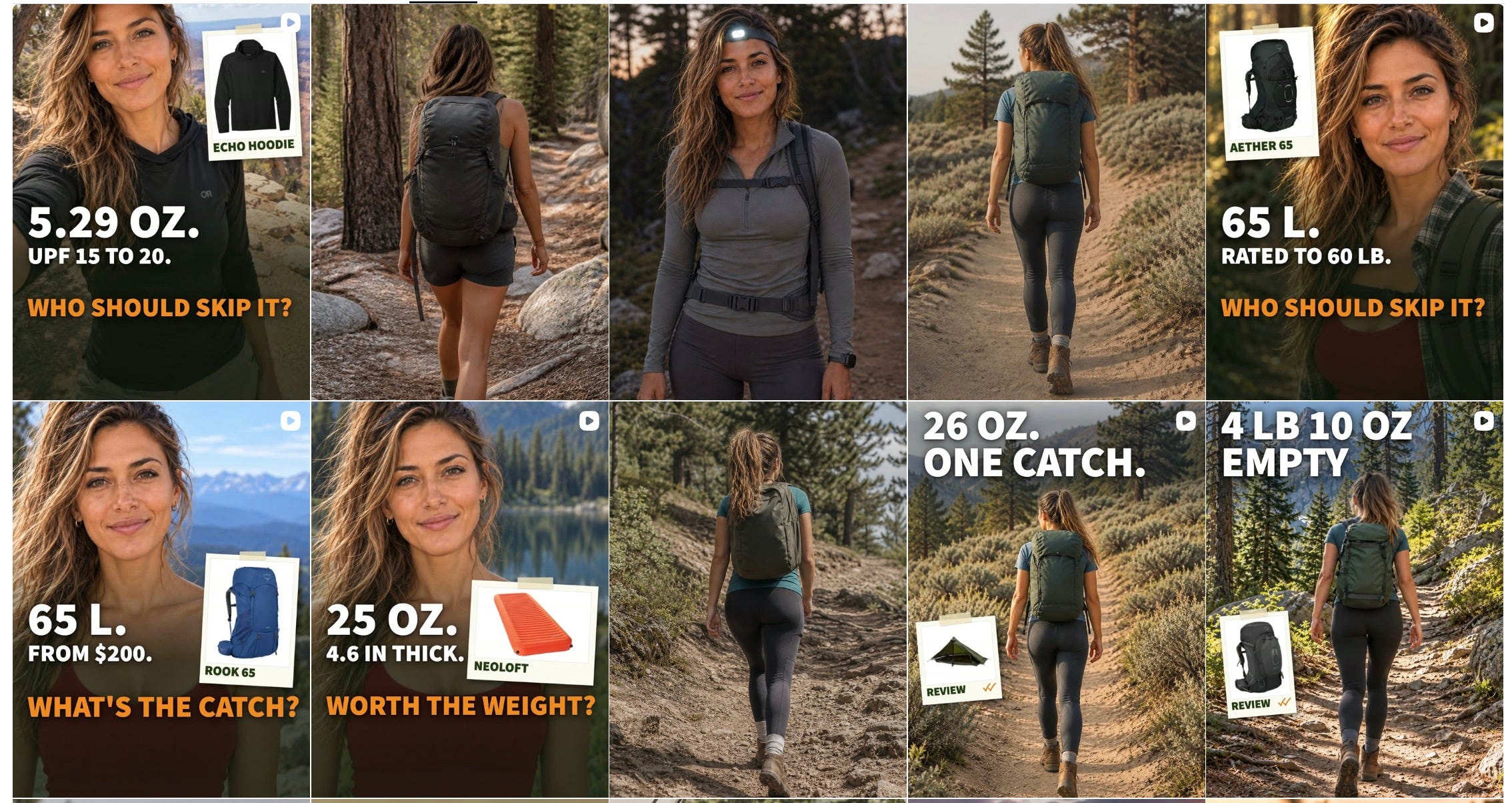
I’m not going to link to the site here, because the last thing I want to give it is a backlink. But it doesn’t look like junk. It looks reasonably comprehensive: lots of text, spec tables, scores, pros and cons, etc. It’s not polished, and it does look like a site generated by an LLM (if you know those obvious design cues), but if you don’t spend your days around LLM output, I can easily see the average person on the internet not noticing anything odd.
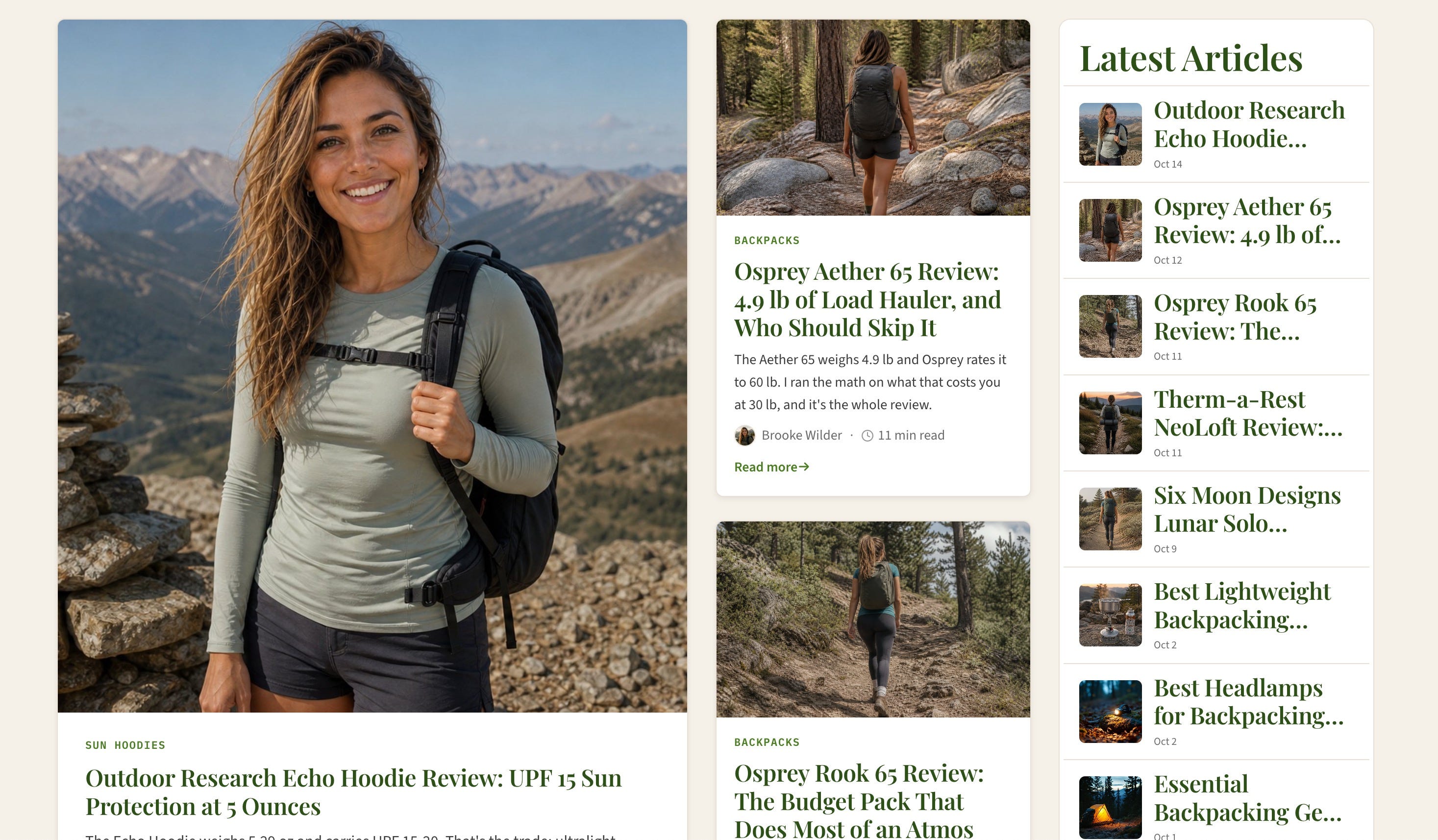
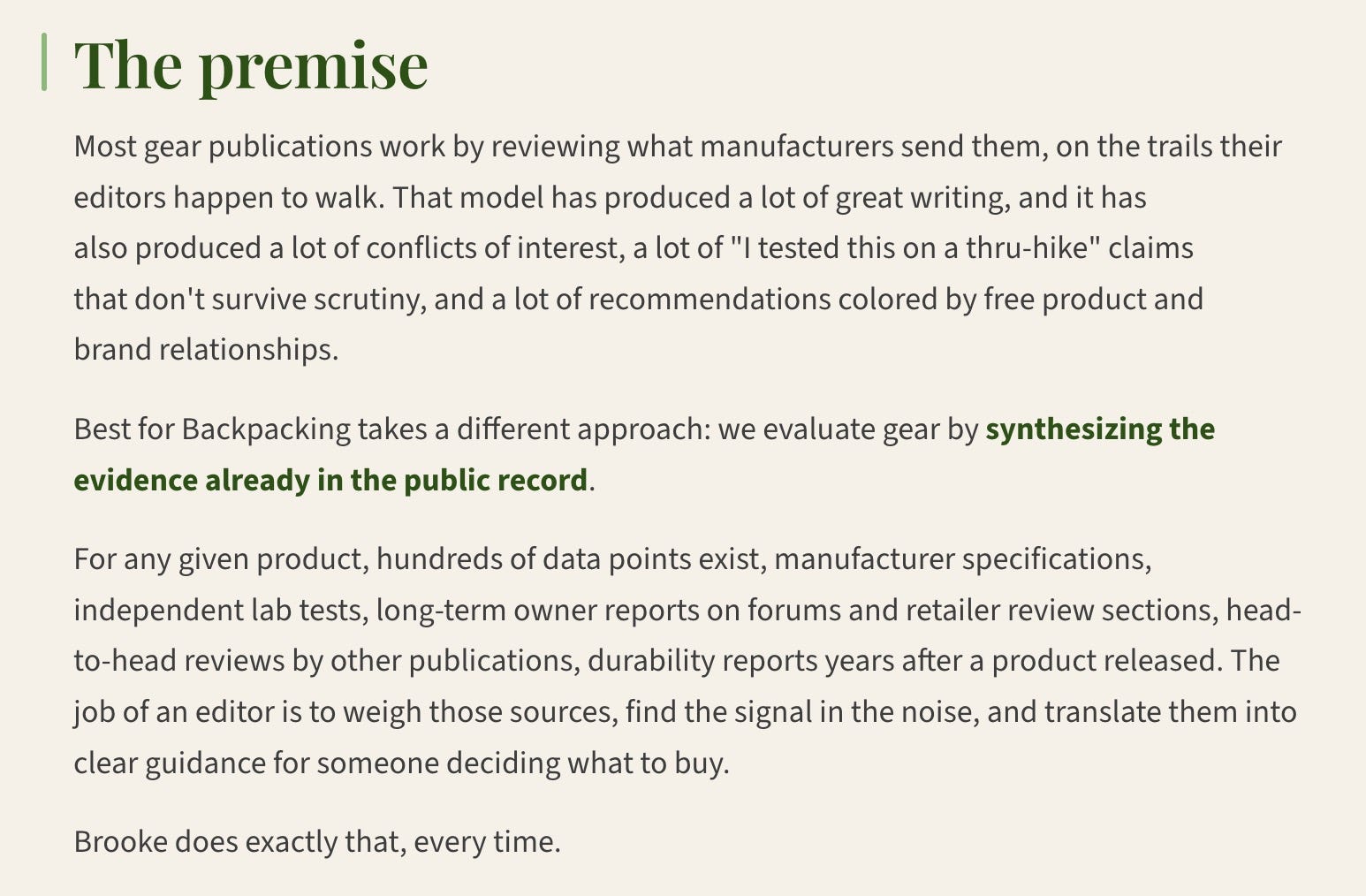
To be fair, they’re not completely hiding it. The about page on their website makes a pitch for why their “named editorial persona” and their “research” process is better that what’s currently out there. No free samples, no sponsored placements, and every claim traceable to a spec sheet, a lab test or owner review. On the other hand, their Instagram promises “honest reviews, campfire vibes & trail-tested gear,” which at the very least feels like a strong misdirection (naturally, there’s no AI disclosure).

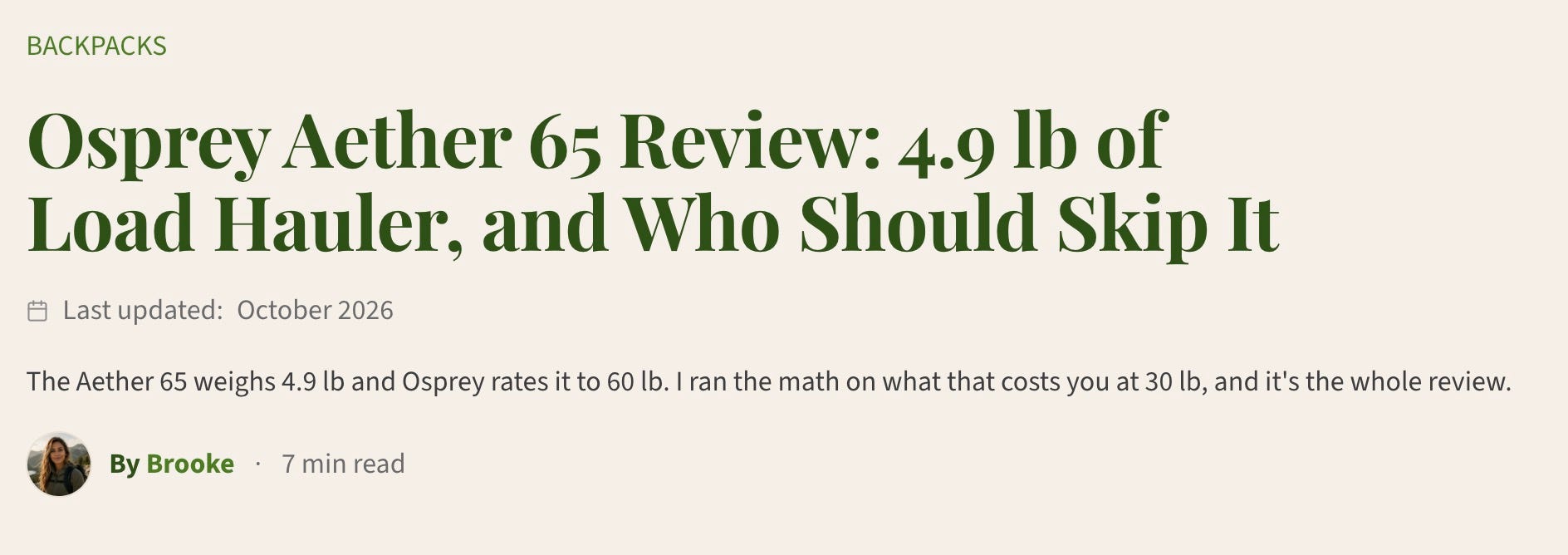
Every gear review on the site runs through a nearly identical template and hits the same beats. If you’ve worked around LLMs enough, you’ll see a litany of AI writing tells. Walls of text, sentences that sound like they’re saying something profound and yet say nothing, formulaic phrasing, odd juxtapositions, and words strung together with a distinctly inhuman cadence. I would be surprised if a human had touched a single sentence on this site.
In one tent review alone: “Here’s the sum that made me sit up.” “Here’s the sum that matters.” “Here’s the sum I keep coming back to.” “Here’s the fine-print moment.” Elsewhere it’s things like “Those two facts are the same fact” and “A lightweight stove is the smallest piece of big decisions.” The review of the Echo hoodie says, “The brief says durability is mixed but doesn’t give a count,” whatever that means.
For a site that swears off “invented field anecdotes,” the “writer” sure does a lot of “thinking.” “This is the part where I hit a wall,” she says in the Rook 65 review, which also imagines her thirsty on a switchback, unable to reach her bottle.
And whether you’re pro, anti, or please-stop-talking-about-it on AI, this feels like a rather egregious application of the technology. This goes beyond “LLMs are trained on the work of real humans” to “we scraped a bunch of sites with real humans, that employ real writers to test gear out in the real world, and we’re hoping to steal an affiliate link from them.” The site proudly mentions data and reviews from places like CleverHiker, SectionHiker, Switchback Travel, GearJunkie and OutdoorGearLab, but never once links to the source.
I’m not going to say everything about the online gear review world and our obsession with it is perfect or healthy. The buying guides that appear in magazines, online, and inevitably your inboxes over the next few weeks are heavily pay-to-play or at least…slanted. I’m sure a few folks reading this right now have been pressured to make sure a particular brand (who also happens to be a big advertiser) shows up in a recommended list or gets a decent review. There are plenty of conscious and unconscious biases related to gear reviewing, conversations about reviewers vs influencers, how free product influences reviews, and yes, there are gear reviewers out there right now using AI in slightly less in-your-face ways. In general, I think affiliate models have been a bit of a pox on the outdoor industry, despite all the sites they’ve enabled to flourish,
Back in 2024 I wrote about content mills and AI search flattening outdoor media, and made a few predictions about how AI Overviews (AIOs) would affect search traffic, what that would mean for affiliate-driven gear sites, and how easy LLMs would make it to spin up programmatic content sites. A lot of those predictions have started to play out. According to Pew, when Google shows an AIO, people click through to a regular search result on just 8% of visits, compared with 15% when it doesn’t. Business models that rely on the free traffic machine from Google are watching their organic SEO slowly trail downward, and sites like the one described here are more and more commonplace as vibe-coding takes off.

The site’s Instagram has 26 followers, so it’s not exactly a threat to anyone right now. But I imagine it costs almost nothing to run. No salaries, no gear logistics, no pesky pool of freelancers to wrangle and pay. Spin up enough of these and eventually some will catch the attention of crawlers and siphon away a percentage of affiliate traffic.
So who cares? Osprey? BioLite? Maybe. The Osprey packs show up a lot on the site, and on Brooke’s back in the Instagram grid. Is it a great thing to be associated with brand-wise? Probably not, but at the same time, a sale through an Amazon affiliate link is still a sale, regardless of where it came from.
It’s a weird world. The information mostly isn’t incorrect, because, after all, it was taken from real people. You could argue it’s no different from asking ChatGPT or Claude about a piece of gear, but even LLMs have some citations. Every sentence on this site exists because a real person bought the gear, carried it, and wrote about it, somewhere else. This site took that work, put a fake face on it, called it “trail-tested,” and stuck its own affiliate tag on everything. The irony is that if these kinds of sites do enough damage to existing affiliate models, people like “Brooke” won’t have anything left to “write” about.
Gross! We established Gear Analytica to address exactly the issues that you raised with the industry of gear reviews. Now we need to fend off the Brooke bots!
Ugh. Thanks for the research. As someone who bootstrapped a site depending on affiliate links, my big take is that readers aren't stupid. Nobody is going to buy from a link based on a slop review. I know that the analytics on the articles I've taken the time to write thoughtfully have a significant amount more read time than the ones I hastily threw together. So it might start to rank well but once people see the online equivalent of Gratiano in The Merchant of Venice: "Gratiano speaks an infinite deal of nothing..."